- When Should You Disconnect a Car Battery?
- What You'll Need
- How to Disconnect a Car Battery
- Why Negative First?
- How to Remove a Car Battery
- How Many Volts is a Car Battery?
- How to Reconnect the Battery
- Dealing with Corrosion
- Safety Tips to Remember
- What Happens After You Disconnect
- When to Call for Help
- The Bottom Line
Look, I get it. The first time you need to disconnect your car battery, it can feel a bit intimidating. All those wires, the fear of getting shocked, or worse, breaking something expensive. But here’s the truth: it’s actually one of the easier car maintenance tasks you can do yourself, and I’m going to walk you through it step by step.
When Should You Disconnect a Car Battery?
You might be wondering why you’d even need to disconnect your battery in the first place. There are actually quite a few situations where this comes in handy.
If you’re storing your car for a while—maybe you’re heading out of town for a few months or putting your classic ride away for winter—disconnecting the battery prevents it from slowly draining. Even when your car is off, little things like your clock and alarm system are still sipping power.
Planning to work on your car’s electrical system? Always disconnect the battery first. It’s like turning off the breaker before doing electrical work in your house. You don’t want any unexpected sparks or shorts while you’re elbow-deep in wiring.
Your battery might also need to come out if it’s dead and needs replacing, or if you’re cleaning up corrosion around the terminals. Sometimes mechanics will also tell you to disconnect it before doing certain repairs, just to be safe.
What You’ll Need
Before we get started, grab these things:
- A wrench or socket set (usually 8mm, 10mm, or 13mm—check your battery terminals)
- Safety glasses (I know, I know, but trust me on this one)
- Gloves (optional, but nice to have)
- A wire brush if there’s corrosion
- Some baking soda and water if things are really crusty
How to Disconnect a Car Battery
Alright, let’s do this. It’s easier than you think.
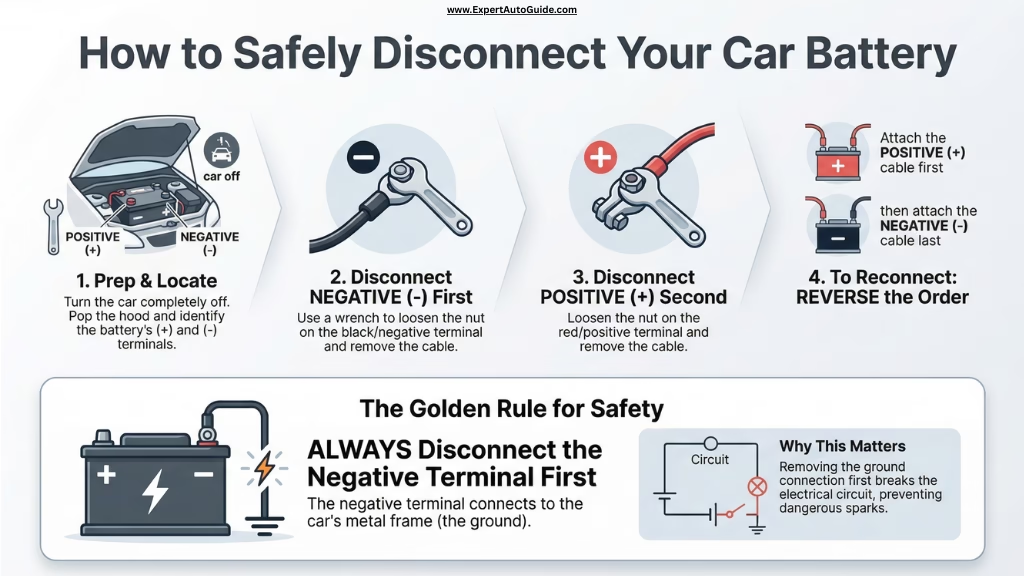
Step 1: Turn everything off. Make sure your car is completely off. Keys out of the ignition. Lights off. Everything.
Step 2: Pop the hood. Find that little lever inside your car (usually down by your left foot) and pull it. Then go to the front of the car and lift the hood. Most hoods have a safety latch you’ll need to push or pull.
Step 3: Find your battery. It’s usually a black or gray rectangular box with two cables attached. Can’t miss it. Sometimes it’s tucked in a corner or has a plastic cover you need to remove first.
Step 4: Identify the terminals. You’ll see two terminals—one marked with a plus sign (+) and usually covered with a red cap or cable, and one marked with a minus sign (−) with a black cable. This is important.
Step 5: Disconnect the negative terminal FIRST. This is the golden rule. Always negative first. The negative terminal is the black one with the minus sign. Use your wrench to loosen the nut holding the cable clamp. You don’t need to remove the nut completely—just loosen it enough to wiggle the cable off. Once it’s loose, carefully pull the cable away from the terminal and tuck it aside so it doesn’t accidentally touch the terminal again.
Step 6: Now disconnect the positive terminal. Same deal here. Loosen the nut on the positive (red) terminal and remove the cable. Keep this one away from any metal parts of the car.
And that’s it! Your battery is now disconnected.
Why Negative First?
You’re probably wondering why we disconnect the negative terminal first. Here’s the deal: the negative terminal is connected to your car’s metal frame (the ground). If you removed the positive terminal first and your wrench accidentally touched any metal part of the car while still touching the positive terminal, you’d create a circuit and get a nice big spark. Not fun. By removing the negative first, you break that ground connection, making everything safer.
How to Remove a Car Battery
If you need to actually take the battery out of the car completely, there are just a couple more steps.
After disconnecting both cables (negative first, remember), look for the battery hold-down. This is usually a bracket, bar, or clamp that keeps the battery from bouncing around while you drive. It might be held in place with a bolt or two at the base, or there might be a bar across the top. Use your wrench or socket to remove whatever’s holding it down.
Now here’s where you need to be careful: car batteries are heavy. We’re talking 30 to 60 pounds depending on the battery. Get a good grip on both sides and lift straight up. Don’t tip it if you can help it—batteries can leak acid, and you definitely don’t want that on you or in your engine bay.
Once it’s out, set it on something flat and stable. A piece of cardboard or wood works great.
How Many Volts is a Car Battery?
Since we’re talking about batteries, you might be curious about the voltage. A standard car battery is 12 volts. Well, technically when it’s fully charged, it’s actually around 12.6 to 12.8 volts, but we just call it a 12-volt battery.
If you’re checking your battery with a multimeter and it’s reading below 12.4 volts, it’s getting low and probably needs a charge. Anything below 12 volts when the car is off means your battery is pretty much dead.
When your car is running, the alternator charges the battery, and you should see around 13.7 to 14.7 volts. That’s normal and healthy.
How to Reconnect the Battery
When you’re ready to hook everything back up, you do it in reverse order.
Positive first this time! Connect the positive (red) cable to the positive terminal and tighten it down. Then connect the negative (black) cable to the negative terminal and tighten that one too. Make sure both connections are snug—you don’t want them wiggling around.
You might see a small spark when you connect that last cable. That’s totally normal. It’s just the electrical system coming back to life.
Dealing with Corrosion
Sometimes you’ll find crusty, white or blue-green stuff around your battery terminals. That’s corrosion, and it can actually prevent your battery from working properly.
If you see this, you’ll want to clean it before reconnecting. Mix a tablespoon of baking soda with a cup of water and pour it on the corrosion. It’ll fizz up—that’s the chemical reaction doing its job. Let it sit for a minute, then scrub with a wire brush. Rinse with plain water and dry everything off before reconnecting.
You can also buy battery terminal cleaners and anti-corrosion spray at any auto parts store. They work great and aren’t expensive.
Safety Tips to Remember
A few things to keep in mind:
Don’t smoke or use anything with an open flame near a battery. They give off hydrogen gas, which is flammable.
Try not to touch both terminals at the same time with a metal tool. That’s asking for sparks.
If your battery is cracked or leaking, don’t mess with it yourself. The acid inside is nasty stuff. Get a professional to handle it.
And seriously, wear those safety glasses. If you accidentally cause a spark near the battery, you don’t want anything flying into your eyes.
What Happens After You Disconnect
Just so you know what to expect: after disconnecting your battery, your car will lose some of its memory. The radio will probably forget your presets, the clock will need to be reset, and your car might drive a little funny for the first few miles while the computer relearns your driving habits. All of this is completely normal.
Some newer cars might also lock you out or give you trouble starting if the battery’s been disconnected. Check your owner’s manual if you’re worried about this.
When to Call for Help
Most of the time, disconnecting a battery is straightforward. But if your battery is in a really weird spot (looking at you, some German cars), or if there’s a ton of corrosion, or if you’re just not comfortable doing it, there’s no shame in getting help. A mechanic can do it in five minutes, or you can ask a car-savvy friend.
The Bottom Line
Disconnecting a car battery really isn’t complicated once you know the steps. Negative off first, positive off second. Reconnect in reverse. That’s the whole secret.
The first time might take you fifteen minutes while you’re being extra careful and double-checking everything. The second time? You’ll probably have it done in five. It’s one of those skills that seems mysterious until you actually do it, and then you wonder why you were ever worried about it.
So next time your car needs some electrical work or you’re storing it for a while, you can handle it yourself. Just remember those safety basics, take your time, and you’ll be fine.
And hey, now you can be the friend who helps other people with their car batteries. That’s a pretty useful skill to have.


